by Sarah Williams
My dear Mrs Goddard I cannot paint our distress.
My dear Sally lept out of a Window last Night and is gone.
We learn Miss Butler of the castle is with her. I can say no more….
We are in the utmost distress and I am sure you pity us.
Lady Betty Fownes 1
‘Sally’ was Sarah Ponsonby: orphan, charge of her late father’s cousins Sir William and Lady Betty Fownes who lived in a grand house on the banks of the river Nore in south east Ireland. Eleanor Butler ‘of the castle’ was intellectual, passionate, a woman of biting wit. Aged twenty-nine she was asked to keep a friendly eye on Sarah who’d been placed at Miss Parke’s School near Kilkenny castle in 1768.
Eleanor made a big impact on teenage Sally.
The two women were drawn together by a love of French philosophy, long walks and novels such as Clarissa and Millenium Hall, and planned to live together in romantic retirement, à la Rousseau. Retirement, eighteenth-century-style, meant a retreat from fashionable society to a picturesque setting where one could concentrate on ‘improving’ activities: reading, learning languages, gardening, sketching, charitable works.
The runaways are caught, and we shall soon see our amiable friend (Sarah Ponsonby) again, whose conduct, though it has an appearance of imprudence, is, I am sure, devoid of serious impropriety. There were no gentlemen concerned, nor does it appear to be anything more than a scheme of romantic friendship.
Mrs Tighe, Lady Betty’s daughter
Sarah’s dramatic leap from a window, complete with pistol and lapdog Frisk, had got them nowhere – the two women were caught and separated; ‘Sally’ feverish after sleeping in a barn; Eleanor distraught, desperate, under pressure.
The eighteenth century concept of Romantic Friendship that Mrs Tighe refers to has disappeared. It might once have been helpful to lesbian couples hoping to avoid scandal. It perhaps appeals, for different reasons, in the twenty-first century – and may be making a return under the umbrella of Queerplatonic – because it offers a more fluid idea of love and passion, suggesting that such very intense feelings aren’t always restricted to sexual relationships.
There is a less appealing side to the concept of romantic friendship, perhaps. Lillian Faderman has described the lifestyle of the Ladies of Llangollen as ’conservative’. They were not quite the social rebels they might seem. The context of their rural retirement was understood by fashionable intellectuals, and they were still women of their background and class in certain ways. If eighteenth-century women kept within particular boundaries, had wealth or status and were sexual beings only in relationship to men, they were invisible. Once a woman stepped outside the boundary, the cloak was removed and they could be seen – and seen as ‘unnatural … liking [their] own sex in a criminal way’2.
Eleanor and Sarah’s first attempt at elopement failed but a second attempt was quietly allowed to take place, so worn down was everyone by trying to keep the two women apart.
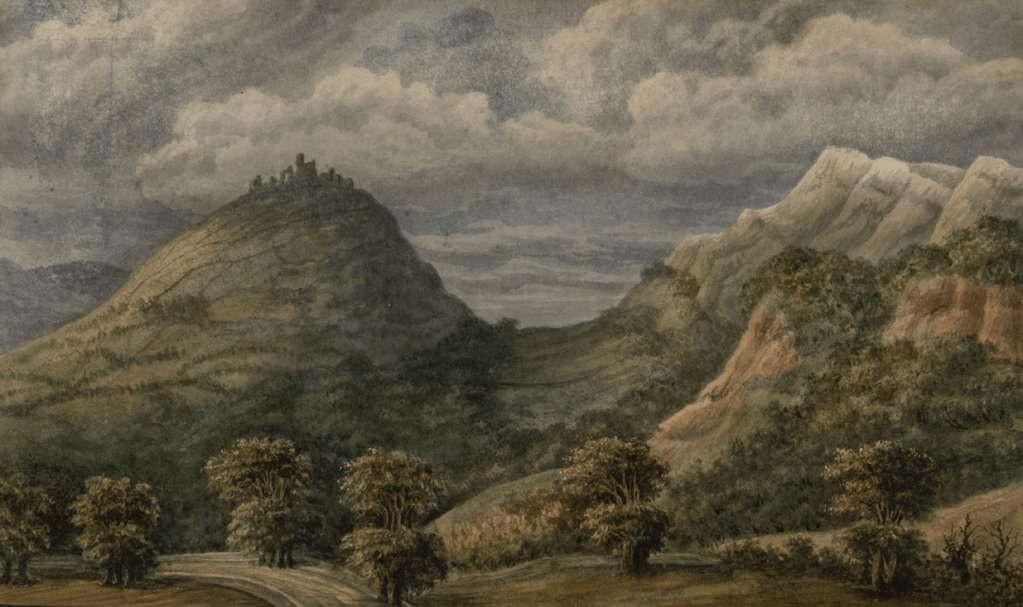
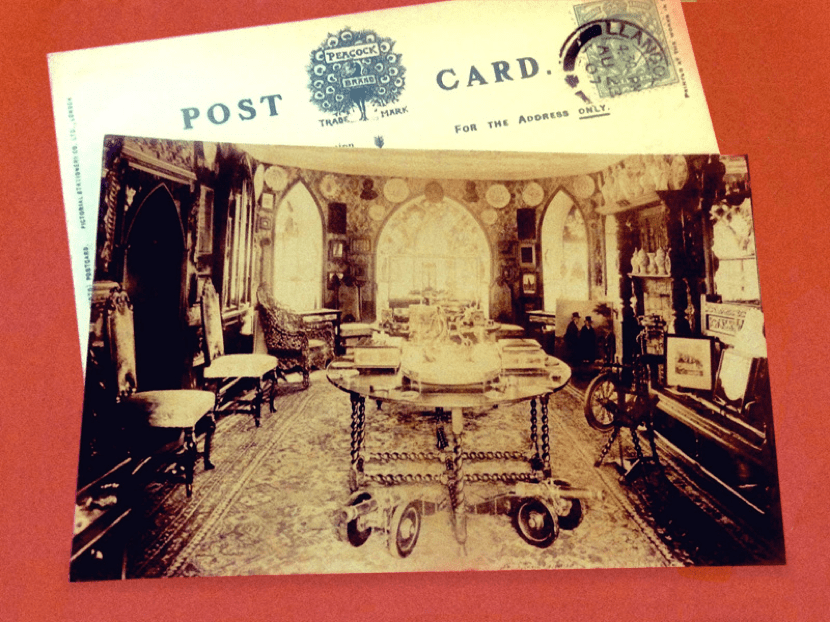
The flight to Wales ended with Eleanor and Sarah settled in the Vale of Llangollen. There they found a simple stone cottage with windows symmetricaly placed, like a child’s drawing. Plas Newydd came complete with a sublime peak hanging over it and a thrilling ravine for melancholy and ‘improving’ walks. The cottage was soon to be ‘improved’ too, its plain windows gothicked beyond recognition. The picture below, shows Plas Newydd’s interior, intensely decorated with wooden paneling and carving, some presented as gifts by guests, some collected from abandoned grand mansions or churches – representing the life the Ladies left behind, perhaps.
This saloon of the Minervas contains the finest editions, superbly bound, of the best authors, in prose and verse … The fruit-trees are of the rarest and finest sort, and luxuriant in their produce; the garden-house, and its implements, arranged in the exactest order…. Nor is the dairy-house, for one cow, the least curiously
elegant object of this magic domain.
Anna Seward
Their lifestyle – the cottage with its wild setting, its simple dairy, its forty varieties of rose, its ornate kitchen gardens, its peach trees and vines, its wonderful library of finely-bound books – their initials embossed in gold: E.B. on the front, S.P on the back – attracted the intellectuals and socialites of the day. Lady Caroline Lamb, Arthur Wellesley, Anna Seward, Thomas De Quincey, Robert Southey visited; Wordsworth composed a sonnet in their garden. They were able to live as they wanted without being the subject of salacious gossip.
I kept my bed all day with one of My dreadful Headaches. My Sally, My Tender, My Sweet Love lay beside me holding and supporting My Head till one o’clock.
Eleanor Butler’s journal, 2 December 1785 1
The Ladies’ lifestyle didn’t just appeal to the fashionable though, as this touching account from a nineteenth century vicar makes plain.
I well remember when I first visited this place, many summers ago, what were my feelings when their story was told me, It was in that era of life when one ‘listens to the whispers of fancy and pursues with eagerness the phantoms of hope’, when one takes the world to be what it seems and sees not the impress of the Fall.I well remember how deeply I was interested, and how strongly I desired ‘to go and do likewise.
James Johnson Diary of a Journey into North Wales with Major Evans in September & October 1841 3
Newspaper accounts from a slightly later period, offer a similar view of them, albeit more sugary and sentimental.
There was another Lady of Llangollen, however, and her name appears on one side of the three-sided memorial outside Llangollen church – the names of Eleanor Butler and Sarah Ponsonby are on the other two sides. This third lady is Mary Carryll. As a servant she was almost invisible to society then but has a compelling life now in Eleanor’s journal. Mary had been with them from the beginning, helping Sarah to leap from the window all those years ago, and she remained with them until she died in 1809. Eleanor and Sarah died within a few years of each other – Sarah the last to go in 1831.
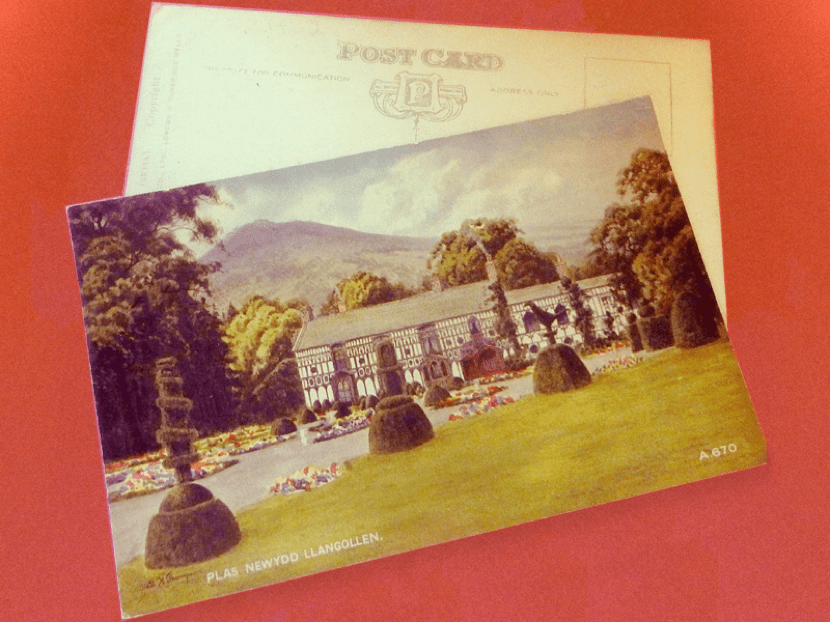
The house is now open to public, but it isn’t quite as it was. Later owners of Plas Newydd, in misguided tribute to the Ladies, further ‘improved’ the house into the strange black and white confection it is today.
The moon steadfast over the centre of our Field attended by stars. What stillness in the air! Her planet glittering in the deep blue expanse. The smoke from our Dressing-room Chimney spinning up in a thick Column. The whole Country covered with the purest most sparkling snow. The silence of the night interrupted by the village clock tolling nine, a dog barking at a great distance, the owl complaining. I could have staid in the field lost in admiration…
Eleanor Butler’s Journal, Saturday January 10th 1789 4
- The Ladies of Llangollen, Elizabeth Mavor, 1971
- From a 1790 diary entry by arts patron, Hester Piozzi, whose estate was near to Plas Newydd. Hester Piozzi is referring to a relationship between two London society women.
- Thanks to my brother, JPD Williams, for this extract from a family journal.
- A Year with the Ladies of Llangollen, Elizabeth Mavor, 1984
© Sarah Williams, originally published 2017
To read more click:


Leave a Reply